Blog
Google Ads or Meta ads, and which a B2B software company should run first
Run Google first if people are already searching for what you sell in useful volume, because harvesting existing demand is cheaper than creating new demand. Run Meta first if they are not, or if search volume is too thin or too expensive to build on. The question is not which platform is better, it is whether your category has search demand yet.
By Uzair, Co-founder · Updated
What is the real difference between them?
One finds people who have already decided they have a problem. The other finds people who have not thought about it today.
Search is intent-triggered. Somebody types a query, which means they have already recognised a need and started shopping, and your ad appears in the middle of that process. You are competing for a person who was going to buy something from somebody.
Paid social is interruption. Nobody opened the app to evaluate vendors. Your ad has to do work that a search ad never has to do, which is to make somebody realise they have a problem worth solving before it can persuade them that you solve it.
That single difference drives everything else: the creative, the cost curve, how long results take, and how you should measure them. Comparing the two on cost per lead without accounting for it produces a conclusion that is arithmetically correct and strategically useless.
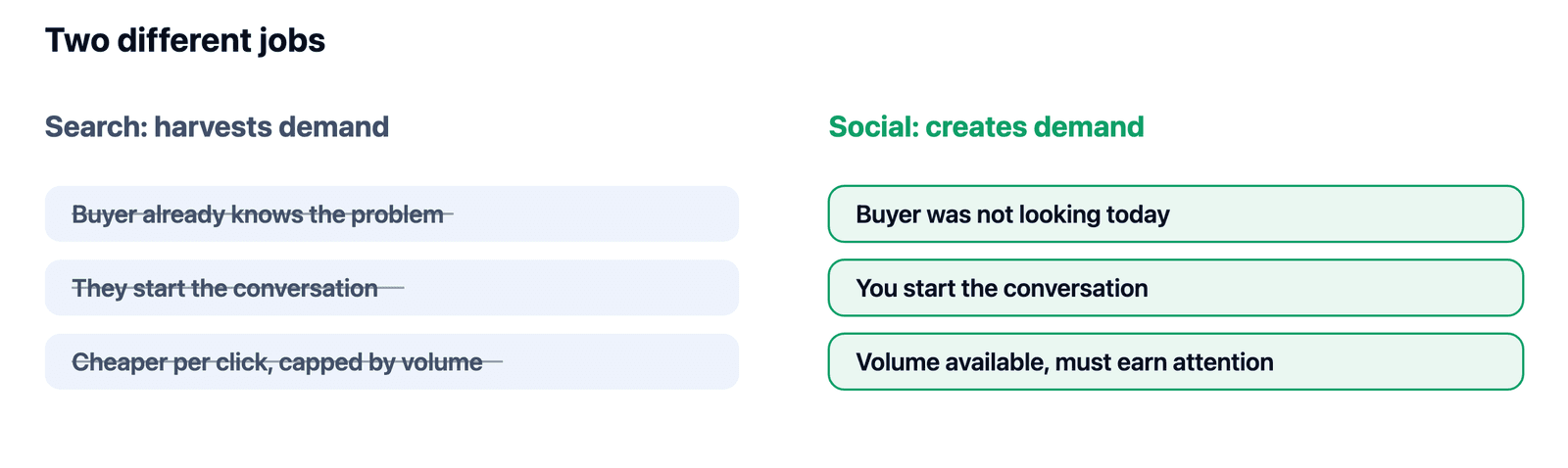
Search harvests demand. Social creates it. Comparing them on cost per lead compares a harvest to a planting.
When should you run Google first?
When there is meaningful search volume for what you sell, and the answer is more often yes than paid social agencies like to admit.
If people search for your category by name, and enough of them do it that the terms would sustain a campaign, start there. Demand that already exists is cheaper to capture than demand you have to manufacture, and the feedback loop is faster because intent is higher and the cycle from click to conversation is shorter.
Established categories with recognised names are the clear case. Managed IT services, CRM software, accounting integrations, anything a buyer knows to look for. If your prospect can name the category, they can search it.
The honest test is to check the volume before deciding rather than after. Keyword volume is knowable in an afternoon, and it turns this from a philosophical argument about channels into a question with an answer.
When should you run Meta first?
When search volume is thin, when it is dominated by budgets you cannot match, or when your product solves a problem people do not yet name.
Thin volume is the most common. Plenty of good B2B products sit in categories nobody searches for, either because the category is new or because buyers describe the problem in words they would never type. You cannot harvest a demand that does not exist, and no amount of bid management fixes an empty query.
The second case is competitive rather than structural. Some categories have search volume priced by companies with far larger budgets, and entering that auction at a small spend buys you the least valuable clicks in it.
The third is the interesting one. If your prospects have the problem but do not know there is a category of solution, search cannot reach them at all and social can. That is the situation paid social is best at, and it is worth being precise about it rather than claiming social is better generally.
What does each channel need from you?
Different things, and underestimating the social side is the more common mistake.
Google needs keyword and negative keyword discipline, landing pages that match the query, and a tolerance for a competitive auction. The work is largely analytical and it compounds slowly and reliably. A well-structured search account degrades gently when neglected.
Meta needs creative, continuously. Not one campaign of assets but a running supply, because social creative fatigues in a way search ads do not, and the account's performance is mostly a function of how good and how fresh the creative is. A social account left alone for two months does not degrade gently.
That asymmetry should shape the decision as much as the demand question. If you have no capacity to produce creative on a rhythm, the honest answer is that Meta will underperform for you regardless of how well the campaigns are set up.
- Google: keyword discipline, matched landing pages, patience with the auction.
- Meta: a continuous creative supply, and the capacity to keep producing it.
- Both: a conversion event worth optimising for, and feedback from sales.
How do they work together once you run both?
Social creates the demand that search then harvests, which means running both makes each look worse in its own report.
This is the measurement trap and it catches almost everybody. Somebody sees a Meta ad, does not click, searches your name a week later, clicks the Google ad, and converts. Google records a cheap branded conversion. Meta records nothing. On a last-click view the obvious conclusion is to cut Meta and put the money into the channel that is quietly living off it.
The tell is branded search volume. If it rises when social spend rises and falls when it stops, social is generating demand that search is collecting, whatever the platform reports say.
So watch branded search as a diagnostic, and judge the pair on total pipeline against total spend rather than on either dashboard alone.
If branded search volume tracks your social spend, your search account is harvesting demand your social account created, and last-click will tell you to cut the wrong one.
How do you decide without guessing?
Answer three questions in order and the choice usually makes itself.
First, is there search volume for the category, and is it affordable at your budget? That is a research task with a factual answer. Second, can you produce creative continuously, or only in one batch? That is a capacity question about your own team and it is not negotiable by wanting it more. Third, which do you need faster, a result or a market?
If there is affordable volume and you need a result this quarter, run search first. If there is no volume, or you are building a category, run social. If you have both the volume and the creative capacity, run both and measure them together rather than against each other.
The wrong way to decide is by asking a specialist in one channel which channel to use, which is worth remembering while reading this.
At a glance
| Situation | Start with | Why |
|---|---|---|
| Established category, real search volume | Existing demand is cheaper than new demand | |
| New category, nobody searches for it | Meta | Search cannot reach an unformed need |
| Search auction dominated by larger budgets | Meta | Small spend buys the worst clicks in that auction |
| No capacity to produce creative regularly | Social performance is mostly creative | |
| Both available | Both, measured together | Each makes the other look worse alone |
Bring the specific decision, context, and constraint.
We can help identify the next useful test across your audience, offer, creative, qualification, and sales feedback loop.