Blog
What is the minimum Meta ads budget for a B2B company?
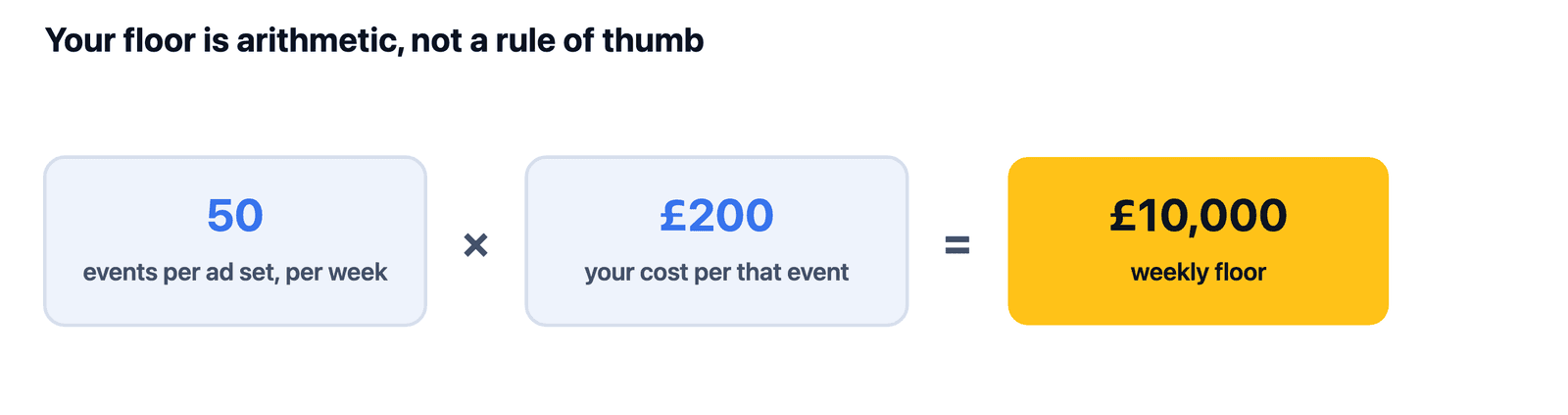
There is no universal minimum, but there is a floor specific to you, and you can calculate it. Meta needs a certain number of optimisation events per week before it can learn, so your floor is that event count multiplied by what one event costs you. Launching below it does not produce slower results. It produces no learning at all.
By Uzair, Co-founder · Updated

Why is there a minimum at all?
Because Meta's delivery system is a learning system, and a learning system needs examples.
When a new ad set launches, Meta does not yet know who responds to it. It spends the early budget finding out, testing across placements and audience segments and watching which combinations convert. That exploration period is the learning phase, and it ends when the system has seen enough conversions to predict reliably rather than guess.
Meta publishes the threshold it uses: roughly fifty optimisation events per ad set per week. Check the current figure in your own account rather than taking that from an article, including this one, because platform thresholds move.
The important part is not the number. It is that the requirement is measured in events, not in money, which is why the answer to how much you need depends entirely on what an event costs you.
The floor is measured in conversions, not currency. Two companies with identical budgets can be on opposite sides of it.
How do you calculate your own floor?
Multiply the weekly event threshold by your cost per that event, then check whether the answer is a number you can commit to for long enough to matter.
If a booked call costs you two hundred pounds and the threshold is fifty a week, the floor for optimising on booked calls is ten thousand a week, which is out of reach for most companies of the size we work with. That is not a failure of the arithmetic. It is the arithmetic telling you that booked calls are the wrong optimisation event for your budget.
So run the calculation for each event you could optimise for, working backwards up the funnel. Booked call, then qualified lead, then lead, then landing page view.
The right optimisation event is the furthest down the funnel where the floor is a number you can actually spend. That single decision matters more than almost anything else you will set.
- Pick a candidate optimisation event.
- Find or estimate what one of those events costs you.
- Multiply by the weekly event threshold to get the weekly floor.
- If you cannot commit to that, move one step earlier in the funnel and repeat.
What actually happens if you launch below the floor?
The campaign does not run at reduced effectiveness. It runs without ever leaving exploration, which is a different and worse thing.
An ad set stuck in learning keeps testing rather than exploiting. Delivery stays volatile, cost per result swings week to week, and the numbers never settle into something you can read. Most people interpret that volatility as bad targeting or bad creative and start changing things, which resets the learning and guarantees the pattern continues.
The trap is that it looks like it is nearly working. Some weeks produce good leads, because exploration occasionally lands well, and that keeps the campaign alive long past the point where the budget should have been rethought.
If your results swing wildly and every fix works once and then stops, check whether you are under the floor before you change anything else.
Should you split the budget across several campaigns?
Almost never at a small budget, and this is the most common way companies put themselves below the floor without noticing.
The threshold applies per ad set, not per account. Three ad sets sharing a budget that would clear the floor once will each sit at a third of it, and all three will stay in learning indefinitely. The instinct to test several audiences at once is exactly wrong at this end of the market.
Consolidate instead. One campaign, one ad set, several creatives inside it. You lose the ability to compare audiences cleanly and you gain the ability to get a result at all, which is the better trade when the budget is tight.
Split testing is a thing you earn with volume. Below the floor it is not a test, because neither arm produces a readable number.
The threshold is per ad set. Splitting a floor-clearing budget across three ad sets does not give you three tests, it gives you three campaigns that never finish learning.
How long do you need to hold it?
Long enough to exit learning and then long enough to read what came out of it, which is longer than most budgets are committed for.
A reasonable minimum is a full quarter. The first few weeks go to exploration, the next few produce the first stable numbers, and only after that do you have something worth making a decision on. A budget approved for six weeks will be judged during the noisiest part of its life.
This is the argument for a smaller budget held longer over a larger one held briefly. A campaign that clears the floor for twelve weeks will teach you more than one at double the spend for five.
In B2B there is a second clock running as well, because your sales cycle decides when you find out whether the leads were any good. Plan for both, not just the media one.
What if you cannot reach the floor for any useful event?
Then Meta is not the right channel yet, and the honest answer is to say so rather than to run a campaign that cannot work.
This happens, and it is not a small-company problem so much as a high-value-conversion problem. A company selling six-figure engagements with a long cycle can be too expensive per conversion to optimise on Meta at a budget it is willing to risk.
There are two reasonable responses. Optimise higher in the funnel and accept that you are buying attention rather than leads, measuring on pipeline created rather than on cost per lead. Or spend the money somewhere with a lower floor until your conversion rate or your budget changes the arithmetic.
An agency that runs the numbers with you and concludes the second is more useful than one that takes the budget anyway. This is a question worth asking on a first call.
At a glance
| Optimisation event | Typical cost, relative | Weekly floor |
|---|---|---|
| Booked call | Highest | Out of reach for most small budgets |
| Qualified lead | High | Reachable at moderate spend |
| Lead | Moderate | Reachable at most spends, weakest signal |
| Landing page view | Lowest | Always reachable, teaches the least |
Bring the specific decision, context, and constraint.
We can help identify the next useful test across your audience, offer, creative, qualification, and sales feedback loop.