Blog
Five Meta ads agency pricing models and what each one incentivises
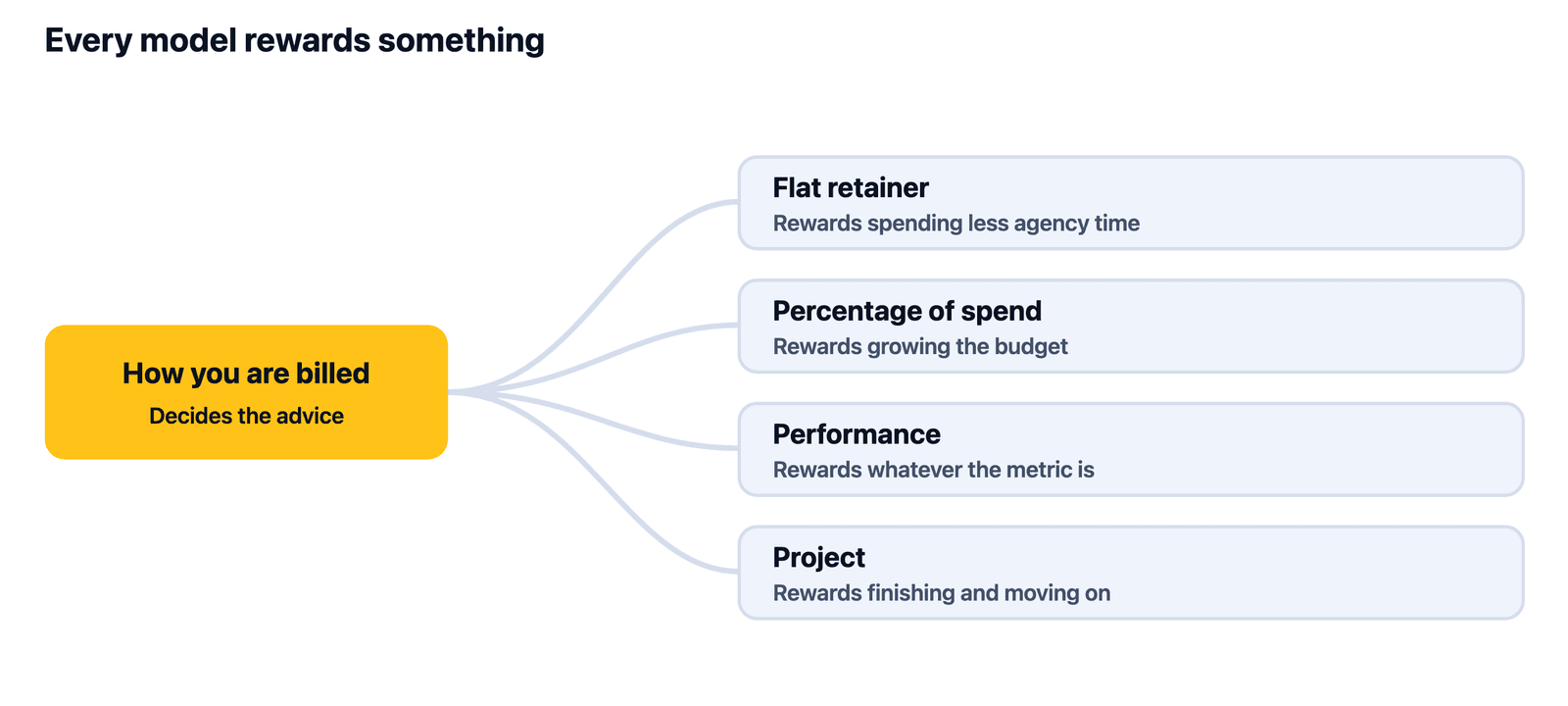
Every agency pricing model rewards some behaviour and punishes another. A percentage of ad spend rewards spending more, a flat retainer rewards spending less of the agency's time, and performance pricing rewards whatever the performance metric happens to be. None of them is dishonest, but you should know which pull you are signing up for before you sign.
By Suleman Aslam Virk, Co-founder · Updated

Why does the pricing model change the work you get?
Because it decides what the agency has to do to make the engagement profitable, and that is a stronger force than intent.
Nobody sets out to give worse advice because of how they invoice. The pressure is quieter than that. It shows up in which recommendation gets made first, which account gets attention on a busy week, and which conversation the agency is reluctant to start. An agency paid on spend finds it awkward to recommend spending less, even when spending less is right.
You cannot remove that pressure by choosing a better model, because every model has one. You can choose which pressure you would rather manage.
So read the model for what it rewards rather than for what it costs. The monthly number is the easy part of the comparison and the least informative.
Ask what each model makes awkward to say. That answer tells you more than the price does.
What are the five models you will be quoted?
Five structures cover almost everything in the market, and most quotes are one of them or a blend of two.
A flat retainer is a fixed monthly fee for an agreed scope. A percentage of ad spend scales the fee with the budget, and the percentage usually falls as spend grows.
A hybrid pairs a base retainer with a smaller percentage on top. Performance pricing ties some or all of the fee to an outcome. And project pricing buys a defined piece of work with an end date, such as an audit or a rebuild.
Blends are common and are not a warning sign. A base plus performance component is often the most honest structure available, because it splits the fixed cost of doing the work from the variable reward for doing it well.
What matters is that you can say out loud what triggers each part of the fee.
- Flat retainer: fixed fee, agreed scope.
- Percentage of ad spend: fee scales with budget.
- Hybrid: base retainer plus a smaller percentage.
- Performance: some or all of the fee tied to an outcome.
- Project: a defined piece of work with an end date.
What does a percentage of ad spend actually incentivise?
Spending more, which is not automatically wrong and is worth naming rather than pretending away.
There is a real argument for it. A larger account takes more work to run, and a percentage keeps the fee proportionate to the size of the job without renegotiating every quarter. It also means the agency carries some of the downside when you cut the budget.
The problem is the moment when scaling back is the right call. Every account reaches a point where the next increment of spend buys worse leads than the last one, and the agency paid on spend is the party least motivated to raise it. That conversation is where this model is tested.
If you go this route, agree in advance what evidence would trigger a recommendation to reduce spend, and who is responsible for raising it. A model with a known blind spot and a written plan for it is safer than a model whose blind spot nobody mentioned.
When is a flat retainer the right structure?
When the scope is stable and you want the fee to stop being a variable in every strategy conversation.
A flat retainer removes the spend incentive entirely. The agency earns the same whether your budget doubles or halves, which makes the advice about budget cleaner than under any percentage model. For an account that is not growing quickly, that clarity is worth a lot.
Its own pressure runs the other way. A fixed fee rewards spending less agency time, so the risk is drift: fewer tests, slower responses, an account that is maintained rather than improved. The failure mode is quiet, because a maintained account does not look broken.
Guard against it with scope rather than trust. Agree what happens each month, not just what it costs, and review whether it happened. A retainer without a defined scope is the weakest of the five structures.
Is performance pricing as aligned as it sounds?
Only as aligned as the metric, and the metric is where these arrangements usually come apart.
Tie the fee to leads and you will get leads, including the ones nobody wanted. Tie it to booked calls and you have moved the incentive somewhere more useful and introduced a dependency on your own calendar and follow-up. Tie it to revenue and you are paying the agency for the performance of your sales team as well as its own.
There is also a practical problem. Performance pricing needs clean attribution to settle, and attribution in B2B is contested at the best of times. Any model that requires both sides to agree on a number produced by an imperfect system will eventually produce an argument about that number.
It works well as a component and badly as the whole fee. A base that covers the work plus an upside tied to a metric you both trust is the version that survives contact with a real quarter.
Performance pricing does not remove the incentive problem. It moves it onto whichever metric you chose, so choose one you would be happy to be gamed on.
What should you ask about pricing before you sign?
Six questions, and none of them is about the number.
What exactly does the fee cover, and what is billed separately? What happens to the fee if we increase or decrease spend? What is the minimum term, and what does the exit look like? Who owns the ad account, the pixel and the creative when we leave? Is there a setup fee, and what does it buy? And what does a normal month of work actually contain?
That last question is the one that separates a scope from a price. An agency that can describe a normal month in specifics has one. An agency that answers in adjectives is selling you availability.
Get the answers in the proposal rather than in conversation, for the same reason you would want any other commitment written down.
- What does the fee cover, and what is billed separately?
- What happens to the fee if spend goes up or down?
- What is the minimum term, and what does leaving involve?
- Who owns the ad account, pixel and creative afterwards?
- Is there a setup fee, and what does it buy?
- What does a normal month of work contain?
Why is our own pricing not on this page?
Because what we charge depends on the account, and publishing a number would mean publishing one that is wrong for most people who read it.
That is a real reason and it is also convenient for us, so treat it accordingly. Not publishing a price costs you something as a reader: you cannot compare us against the models described above without a call, which is exactly the friction that makes a published price valuable to buyers and uncomfortable for agencies.
What we will do is tell you the shape and the number on the first call, before you have spent anything but the half hour, and put both in the proposal rather than leaving them in a conversation you have to remember accurately.
If a price on the page is what you need to evaluate anyone, that is a legitimate requirement, and an agency that will not give you one in the first conversation is not worth the second.
At a glance
| Model | Rewards | Failure mode |
|---|---|---|
| Flat retainer | Efficiency for the agency | Drift into maintenance, no new tests |
| Percentage of spend | Growing the budget | Reluctance to recommend spending less |
| Hybrid | A mix of both | Complexity, two things to renegotiate |
| Performance | Whatever the metric is | Arguments about attribution at settlement |
| Project | Finishing and moving on | No ownership of what happens next |
Bring the specific decision, context, and constraint.
We can help identify the next useful test across your audience, offer, creative, qualification, and sales feedback loop.