Blog
Which paid media performance guarantees are real and which are theatre
A paid media guarantee is only real if the target is written down before launch, the client-side conditions are finite and specific, and the remedy triggers automatically rather than at the agency's discretion. A guarantee that fails any one of those three is marketing copy, however confidently it is worded.
By Suleman Aslam Virk, Co-founder · Updated

Why are most agency guarantees unenforceable?
Because they are written to be unfalsifiable rather than untrue, which is a different and more comfortable thing.
There are three standard ways to do it. The first is the definition loophole: the target is stated in a unit nobody has defined, so leads, qualified leads and opportunities can be swapped for each other after the fact. The second is the conditions loophole, where the client-side requirements are adjectives.
Prompt follow-up, timely approvals, a functioning sales process. Each is a judgement the agency makes afterwards, which means the guarantee applies only when the agency agrees it does.
The third is the remedy loophole. What actually happens if the target is missed, and who decides? If the answer is a conversation, there is no guarantee, only an intention.
A guarantee you cannot lose an argument about is one you cannot win either.
A guarantee that cannot be argued with is not strong. It is empty. The ability to hold someone to it is the entire product.
What are the five guarantee types you will encounter?
They are not equally serious, and the most reassuring-sounding ones tend to be the weakest.
Money-back is the most concrete and the rarest, because it puts the agency's fee at risk. Free-until-target, which is what we offer, keeps the fee at risk but caps the downside at the agency's own time. Lead-volume guarantees promise a count without promising the count is worth anything, which is why they are so often met and so rarely satisfying.
Return on ad spend or revenue guarantees promise an outcome the agency does not control. And the fifth, we will work until you are happy, is not a guarantee at all; it is a sentence.
Grade the type first, then grade the wording. A weak type dressed in strong language is still a weak type.
- Money-back: the fee is at risk.
- Free-until-target: the agency's time is at risk, the fee is capped.
- Lead volume: a count, with no claim about quality.
- Revenue or return on ad spend: promises what the agency does not control.
- We will work until you are happy: not a guarantee.
How do you grade any guarantee in four questions?
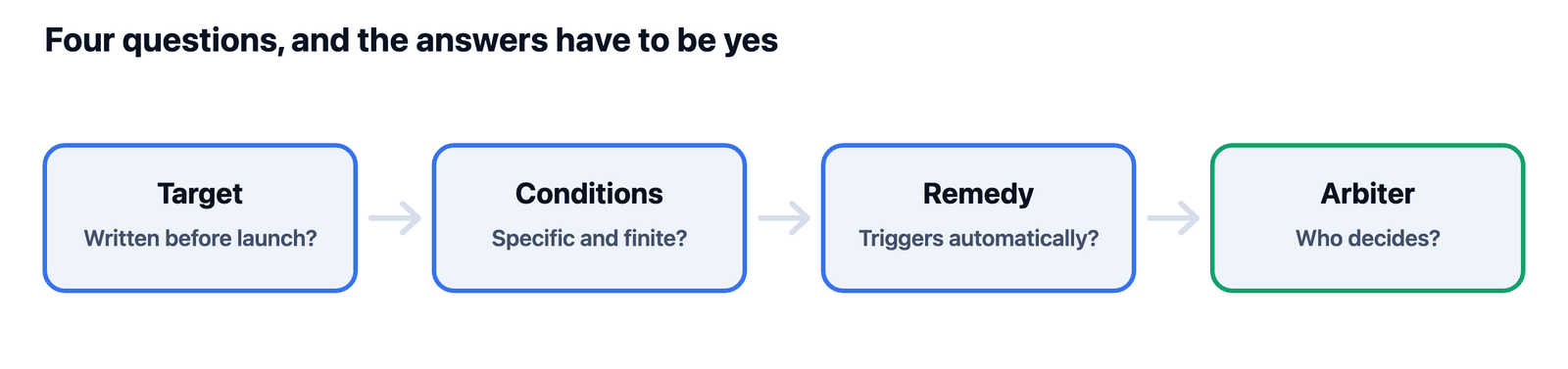
Four questions, and the answers have to be yes. A no on any one of them means the guarantee will not survive the disagreement it exists for.
Is the target written down before launch, in a unit both sides defined? Are the client-side conditions specific and finite, so you can look at them afterwards and agree whether they were met? Does the remedy trigger automatically, or does someone have to be persuaded? And if the two sides disagree, who decides?
That last one is the question almost nobody asks and the one that matters when it matters. A guarantee with no arbitration clause resolves in favour of whoever is more willing to lose the relationship.
Run the four against whatever is in front of you. Most guarantees fail on the second question, and they fail because vagueness there is invisible until it is expensive.
- Is the target written down before launch, in a defined unit?
- Are the client-side conditions specific and finite?
- Does the remedy trigger automatically, or by discussion?
- Who decides if the two sides disagree?
Why is a revenue guarantee a warning rather than a reassurance?
Because the agency does not control the things revenue depends on, and everyone in the conversation knows it.
Between a booked call and recognised revenue sit your sales team, your pricing, your delivery capacity, your close rate, your churn and your market. An agency can influence which calls get booked. It cannot make somebody sign, and it cannot make you deliver.
So a revenue guarantee is telling you one of two things. Either it is hedged somewhere you have not read yet, which makes it theatre, or it was offered by somebody who has not thought about where the boundary of their control sits.
Neither is a reason to relax. The strongest guarantee an agency can give is over the thing it actually runs, which is the cost and quality of the conversations that reach your calendar.
Where does our own guarantee score badly?
We agree a pipeline target before launch, qualified meetings held for a software company or paid sign-ups for a SaaS product, and we keep running the pipeline at no fee if we miss it while the conditions are met. Graded against the four questions, here is where it currently stands.
The target is agreed before launch, so question one passes. Question two is where we score worst. The four conditions are agreed minimum spend, prompt lead follow-up, timely approvals and a functioning sales process. Three of those four are adjectives, and adjectives are exactly what this piece warns you about.
Question three is reasonable: the remedy is that management continues at no fee, which is automatic rather than discretionary. But there is no stated cap on until, and an open-ended promise is harder to hold someone to than a bounded one.
We are fixing the second and third by putting numbers against every condition and a time limit on the remedy. Until that is published, grade ours as you would anyone else's.
Three of our four conditions are currently adjectives. That is the weakest part of our own offer and it is being rewritten with numbers in it.
What should you ask before accepting any guarantee?
Ask for the whole thing in writing, in the proposal rather than in an email thread, before you sign anything.
Then ask four things about it. What exact number are we agreeing, and in what unit? What precisely do you need from me, stated as thresholds rather than adjectives? What happens automatically if you miss, and for how long? And who decides if we disagree about whether the conditions were met?
If those four have clean answers, the guarantee is real and you can rely on it. If they do not, you may still want to work with the agency, but you should price the engagement as though the guarantee does not exist, because functionally it does not.
That is not cynicism. It is the difference between a commitment and a closing line.
At a glance
| Type | What is actually at risk | Usual loophole |
|---|---|---|
| Money-back | The fee | Narrow definition of what counts as failure |
| Free-until-target | The agency's time | No cap on how long until is |
| Lead volume | A count, not a quality | Volume met with leads nobody can use |
| Revenue or return on ad spend | Nothing the agency controls | Hedged in conditions you read later |
| Work until you are happy | Nothing | There is no trigger to fail |
Bring the specific decision, context, and constraint.
We can help identify the next useful test across your audience, offer, creative, qualification, and sales feedback loop.