Blog
Nine reasons your Meta leads are unqualified and how to tell them apart
Bad Meta leads almost always trace to one of three places: the conversion event you optimised for, the amount of friction in the form, or a lead definition sales and marketing never agreed on. Diagnose which before changing anything, because the fixes pull in opposite directions and doing all of them at once tells you nothing.
By Uzair, Co-founder · Updated
How do you tell which cause you actually have?
Start by looking at where the leads fail rather than at the campaign, because the failure point names the cause.
If most leads answer the phone but are the wrong size, wrong country or wrong role, the problem sits in targeting or in the offer. If most leads never answer at all, or say they do not remember filling anything in, the problem is form friction and the click that preceded it. If leads answer, are the right profile, and still do not book, the problem is the follow-up or the offer itself.
Those three patterns rarely overlap, so the split is a genuine fork rather than a list of things to try.
Pull the last fifty leads and tag each one into those three buckets before touching a setting. Twenty minutes of tagging will save a month of changing things and watching nothing move.
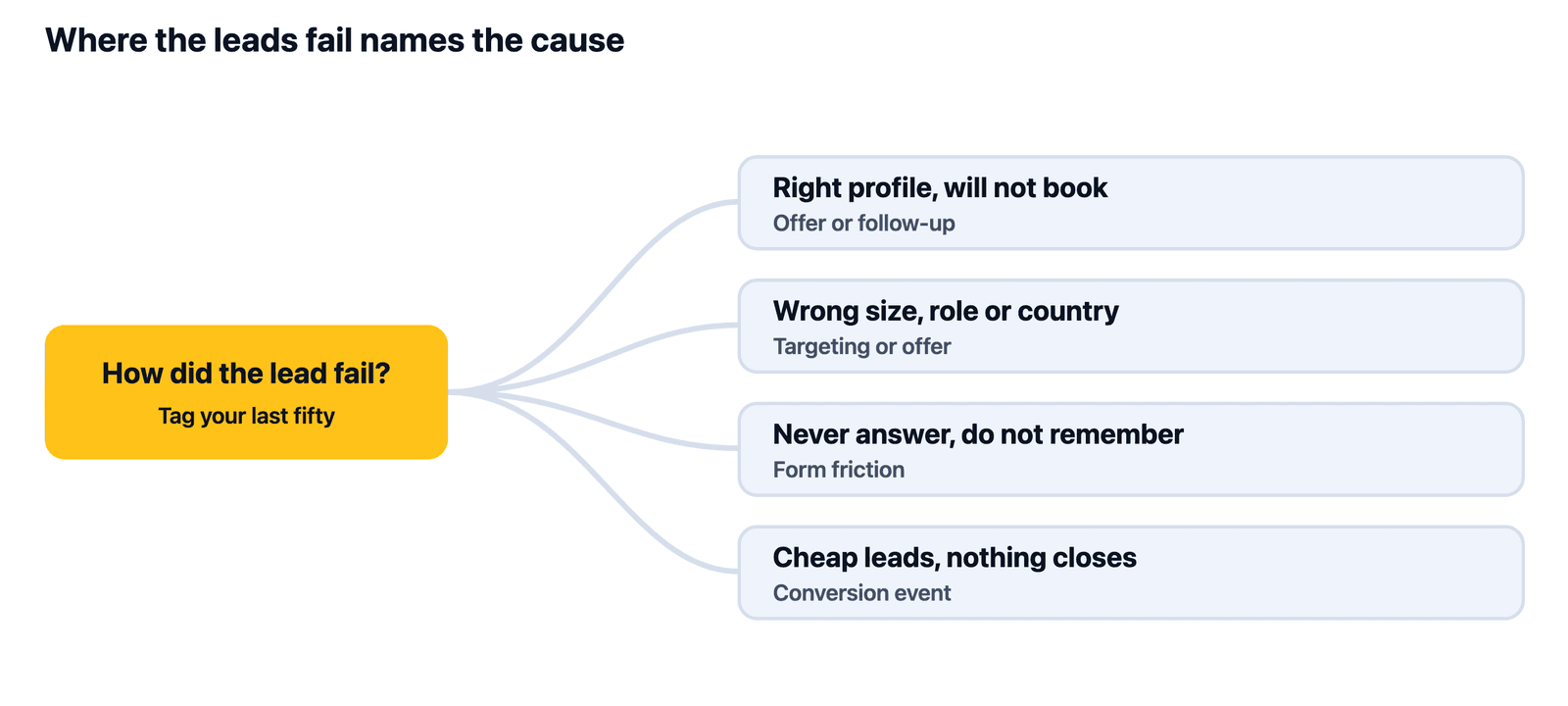
Tag your last fifty leads by how they failed before you change a single setting. The pattern in that tagging is the diagnosis.
What are the nine causes worth checking?
Nine things produce unqualified leads on Meta with any regularity, and they group into the three buckets above.
Four are measurement problems: the wrong conversion event, no offline upload, no agreed definition of a lead, and a follow-up gap long enough to make good leads look bad. Three are form problems: instant forms with prefilled fields, no qualification questions, and an offer that appeals to everyone rather than to buyers. Two are audience problems: targeting with no exclusions, and creative that hides who the product is for.
Most accounts have more than one. That is normal and it is also why single-change fixes so often fail: removing form friction while still optimising for the wrong event just produces fewer leads that are equally bad.
Work the list in the order below rather than the order they annoy you in.
- Optimising for Lead rather than a downstream event.
- No offline conversion upload, so the algorithm never learns who closed.
- No agreed definition of a qualified lead between sales and marketing.
- Follow-up slow enough that good leads go cold and get logged as bad.
- Instant forms with prefilled fields and one tap to submit.
- No qualification questions in the form at all.
- An offer that appeals to everyone rather than to buyers.
- Broad targeting with no exclusions of existing customers or the wrong roles.
- Creative that never says who the product is for.
Why does the conversion event decide lead quality?
Because the algorithm optimises for whatever you told it to count, and it is extremely good at getting you more of that exact thing.
Tell it to find leads and it will find the people most likely to submit a form. That is a real behaviour, and some people do it habitually without any intention of buying. You will get a low cost per lead and a sales team that stops answering the phone.
Tell it to find something further down, a booked call or a qualified opportunity, and it optimises for a rarer, more expensive and far more useful behaviour. Cost per lead goes up and cost per customer usually goes down.
The constraint is volume. Meta needs enough of the event to learn from, so a downstream event that fires twice a month will not train anything. Optimise for the furthest event you can generate consistently, not the furthest one you can name.
Are instant forms making it too easy to say yes?
Usually, yes, and the feature that makes them convert well is the same feature that makes them convert badly.
An instant form prefills name, email and phone from the Meta profile and submits in two taps. Nobody has to type, which means nobody has to think, which means a submission carries almost no evidence of intent. Somebody half-watching a video can send you their details without ever forming an opinion about your company.
Friction is not the enemy here. Friction is the qualifier. A form that asks two questions requiring an actual answer will produce fewer leads and a better list, and the people who drop out at question two were never going to take the call.
Switch to the higher-intent form option, or send traffic to a landing page, and compare cost per booked call rather than cost per lead.
Friction is not a leak in the funnel. On a lead form it is the only qualification you get before the phone call.
What does a real qualification layer look like?
Two or three questions, each one tied to a reason you would actually decline the work.
The test for a good question is whether an answer would change what you do. Asking for company size is useful if you turn away companies under a certain headcount. Asking about current spend is useful if there is a floor below which you cannot help. Asking what someone hopes to achieve is a comfortable question that qualifies nobody, because every answer is acceptable.
Keep it to three at most. Each additional question costs volume, and past three you are filtering out patient people rather than unqualified ones.
Then use the answers. A qualification question you collect and never route on is worse than no question, because it makes the form longer without making the list shorter.
- Ask only what would change your answer about taking the work.
- Two or three questions, never more.
- Prefer specific ranges to open text, so answers can be routed automatically.
- Route on the answers, or do not ask them.
Is your targeting finding people who cannot buy?
Sometimes, though this is a less common cause than most people assume, and it is the one they reach for first.
Broad targeting works on Meta because the algorithm reads the conversion signal better than a manual audience does. The failure is usually not that the audience is too wide but that the signal feeding it is wrong, which puts you back at the conversion event. Narrowing the audience while the event stays wrong just makes bad leads more expensive.
There are two exclusions worth making anyway. Exclude existing customers, who cost you money and cannot become customers twice. Exclude the countries you cannot serve, which sounds obvious and is skipped constantly.
Beyond those two, treat targeting as the last lever rather than the first. Fix what the algorithm is learning from before you change who it is allowed to find.
What do you fix first when several are true?
Measurement first, form second, audience last. That order is not a preference; it is the sequence in which the fixes stop interfering with each other.
Agree a written definition of a qualified lead before anything else, because without one you cannot tell whether a change worked. Then fix the conversion event and get closed deals flowing back to Meta. Then add form friction and qualification questions. Then, only then, touch targeting.
Change one thing at a time and give each change enough volume to read. Two weeks is usually the minimum for a lead-gen account at modest spend, and less than that is noise you will misread as a result.
If you do everything at once and the leads improve, you have improved your leads and learned nothing about why, which means you cannot do it again.
At a glance
| What you observe | Likely cause | First fix |
|---|---|---|
| Right profile, will not book | Offer or follow-up | Agree the lead definition, then speed up follow-up |
| Wrong size, role or country | Targeting or offer | Add exclusions, then sharpen who the creative addresses |
| Never answer, do not remember signing up | Form friction | Move off prefilled instant forms |
| Cheap leads, nothing closes | Conversion event | Optimise for a downstream event and upload closed deals |
Bring the specific decision, context, and constraint.
We can help identify the next useful test across your audience, offer, creative, qualification, and sales feedback loop.