Blog
In-house or agency for Meta ads, and how to decide
The decision is not about cost, it is about whether you can keep a specialist busy and current. Meta rewards continuous attention and the skill decays quickly when it is one person's third priority. Hire in-house when the work is a full role, use an agency when it is not, and be suspicious of any answer that arrives before those numbers do.
By Suleman Aslam Virk, Co-founder · Updated
What are you actually deciding between?
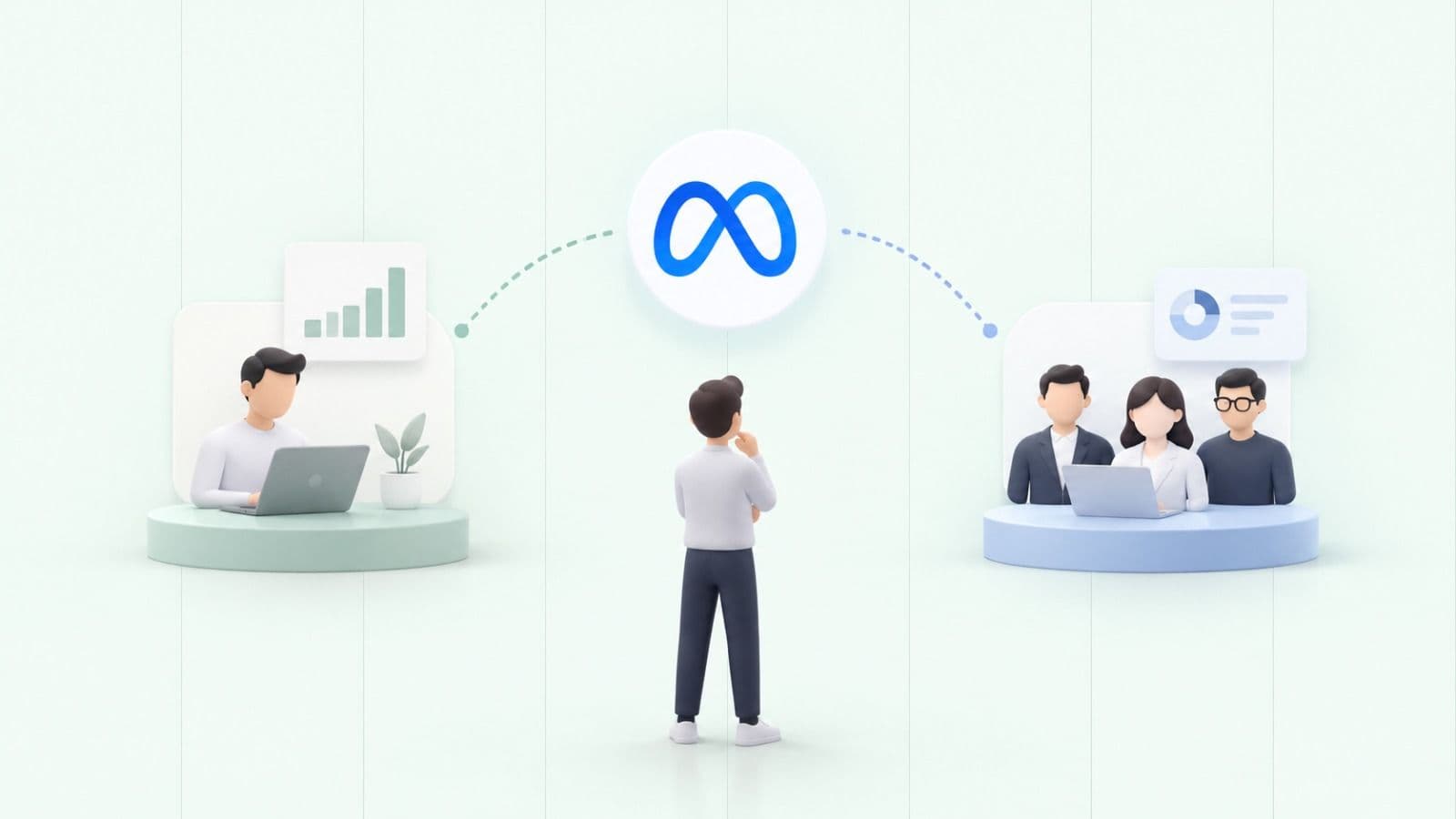
Not agency versus employee. You are deciding how a specific set of recurring tasks gets owned, and there are more than two ways to own them.
The real options are a full-time hire, an agency, a contractor on a fixed number of days, or somebody who already works for you taking it on alongside their job. That last one is the most common arrangement in companies of the size we work with and the least often discussed, because nobody decides on it. It happens by default when the marketing manager inherits the ad account.
Naming it as an option makes it comparable. It has a cost, it has a failure mode, and it should win or lose on the same terms as the others.
Start by writing down the tasks rather than the roles. The list is what you are buying, whoever ends up doing it.
What does running Meta in-house actually require?
More continuity than most people expect and less genius than the discourse suggests.
The recurring work is creative production, which is the largest and most underestimated part, plus campaign management, tracking maintenance, reporting, and the ongoing argument with sales about what a good lead is. Most of that is unglamorous and most of it cannot be batched into one afternoon a month.
Then there is the currency problem. Meta changes what works, what is measurable and what is allowed several times a year, and a person who runs one account learns those changes slowly because they only see one account. This is the structural advantage an agency has, and it is a real one rather than a sales line.
Set against that, an in-house person knows your product, sits near your sales team, and can ship a landing page change the same afternoon. That is also a real advantage and it is usually the decisive one when the account is big enough to justify the role.
- Creative production, continuously, not in batches.
- Campaign structure and daily management.
- Tracking and the conversion loop back from the CRM.
- Reporting somebody outside marketing can read.
- The standing conversation with sales about lead quality.
When is in-house clearly the right answer?
When the work fills a role, and when paid social is central enough that you want the knowledge to accumulate inside the company.
The clearest signal is budget scale. Past a certain spend the agency fee approaches the cost of a competent hire, and at that point you are paying a premium for breadth you no longer need, because your own account now generates more learning than an agency's cross-client view adds.
The second signal is creative volume. If you need a high and constant rate of new creative, having that capability in the building beats commissioning it, both on speed and on how well it sounds like you.
The third is strategic centrality. If paid social is how the business acquires customers, the argument for owning the capability outright is strong even when the arithmetic is neutral, because you should not rent your primary acquisition channel indefinitely.
When is an agency clearly the right answer?
When the work is real but does not fill a role, which describes most companies below a meaningful spend threshold.
A half-time paid social job is a bad job. It attracts people who want a full one and loses them when they find it, and in the meantime the account is run by somebody whose attention is split. Agencies exist largely because this shape of work is difficult to hire for, not because agencies are better at the task.
The other clear case is a standing start. If nobody in the company has run paid social before, an agency compresses the first year of mistakes into a few months, and you can bring it in-house afterwards with a working account rather than a blank one.
The condition attached to both is ownership. If you cannot take the account, the pixel and the creative with you when you leave, you have not outsourced a function, you have rented one back from somebody who holds the deposit.
A half-time paid social job is a bad job. That, more than any question of skill, is why agencies exist at this end of the market.
Does the hybrid actually work?
Yes, and it is the arrangement we see succeed most often, provided the split follows the work rather than the org chart.
The split that works puts creative and product knowledge inside the company and campaign mechanics outside it. Your team knows what the product does and how customers talk, which is exactly what creative needs. The agency knows what Meta changed last month, which is exactly what campaign management needs.
The split that fails is by seniority, where the agency does strategy and somebody junior in-house does execution. That separates the decision from the feedback, and the person who sees what actually happened has no authority to change it.
Whichever way you split it, one named person on each side has to own their half. A hybrid with shared ownership of everything is how work stops happening at the seam.
What does switching actually cost?
More than the notice period, and the costs that hurt are the ones nobody writes into the comparison.
There is a relearning cost, because whoever takes over needs to rediscover what has already been tested, and that history usually lives in somebody's head rather than in a document. There is a signal cost if the ad account changes hands badly, since a rebuilt account starts learning again. And there is a creative gap while the new arrangement builds a library.
Budget a quarter of reduced output for any switch in either direction. Plans that assume a clean handover in a fortnight are the reason switches get judged as failures.
You can shrink all three by insisting on documentation and account ownership from the start, which is worth doing on day one of an arrangement you hope never to leave.
What would make us tell you to go in-house?
A few things, and they come up often enough that we would rather write them down than say them case by case.
If your spend has grown to the point where our fee is close to a good hire's salary, hire. If your product changes fast enough that briefing an outsider costs more than doing it yourself, hire. If you already have somebody strong who wants the job and has the time to do it properly, give it to them rather than to us.
And if paid social is the main way your company gets customers, plan to own it eventually regardless of who runs it now. Using an agency to get there faster is reasonable. Using one permanently for your primary channel is a strategic position rather than an operational one, and it should be a decision rather than a default.
We would rather be the answer for two years and be replaced deliberately than be the answer indefinitely because nobody revisited it.
At a glance
| Situation | Usually right | Main risk |
|---|---|---|
| Nobody has run paid social before | Agency | Not taking ownership of assets |
| Work does not fill a full role | Agency or contractor | Treating it as set and forget |
| Fee approaching a salary | In-house hire | Losing cross-account perspective |
| Fast-changing product, strong marketer | Hybrid | Splitting by seniority instead of by work |
| Paid social is the primary channel | In-house, eventually | Renting the channel indefinitely |
Bring the specific decision, context, and constraint.
We can help identify the next useful test across your audience, offer, creative, qualification, and sales feedback loop.