Blog
Is my Meta account on track? The milestones at 30, 60 and 90 days
At 30 days you should have exited the learning phase and have nothing else worth judging. At 60 days the cost per qualified lead should be within sight of a plausible range. At 90 days it should be stable enough to make a decision on. Judging any of those earlier than the stage they belong to is the most common way a working account gets cancelled.
By Uzair, Co-founder · Updated

What should have happened by day 30?
One thing: the ad set should have left the learning phase. Almost nothing else in the account means anything yet.
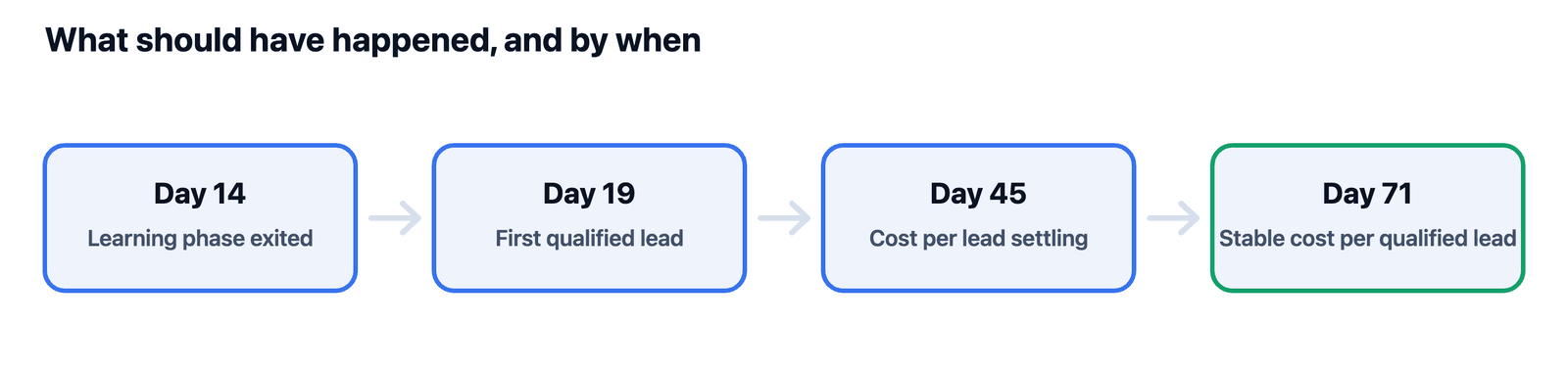
Across the accounts we have measured, the median produced a first qualified lead at around nineteen days, which feels like progress and is a sample of one. A single good lead in week three predicts very little about month three, and a single bad one predicts nothing at all.
What you can legitimately check at thirty days is mechanical rather than commercial. Is the conversion event firing and firing once. Are leads reaching the CRM. Is somebody answering them the same day. Has the ad set accumulated enough events to exit learning, or is it still exploring because the budget was split across several ad sets at launch.
If the account is still in learning at day thirty, that is the finding, and it is a budget or structure problem rather than a creative one.
At thirty days the only real question is whether the ad set left the learning phase. Everything else is still noise wearing a number.
What should have happened by day 60?
A cost per qualified lead you can say out loud, and the first genuine read on whether the message is landing.
By two months there should be enough qualified conversations to compute a cost per one of them, and to compare that against the ceiling you derived from your own customer value. It will not be stable yet. It should be within the same order of magnitude as a plausible figure for your segment, and if it is several times off, something structural is wrong rather than something needing optimisation.
This is also the point at which creative fatigue starts to show in accounts that launched with a single asset, so a rising cost per result in week eight is often a creative supply problem rather than an audience one.
Sixty days is the right time for the first serious conversation with sales about who has been arriving, and the wrong time to cancel.
What should have happened by day 90?
Stability, and with it the first decision worth making.
In our accounts the median time to a cost per qualified lead that stopped swinging enough to change a decision was around seventy-one days, with a quarter of accounts taking longer than a full quarter. So ninety days is roughly when the number becomes a fact rather than a reading.
At that point you can make a real decision: scale it, change the offer, or stop. All three are legitimate and stopping at ninety days on a stable bad number is a good decision, where stopping at forty days on an unstable one is a coin flip you have chosen to call.
You should also, by now, be sending closed outcomes back to the platform. Accounts doing that ran a materially lower cost per qualified lead, and ninety days is about when enough outcomes exist to be worth sending.
- Day 30: out of learning, events firing, leads answered same day.
- Day 60: a computable cost per qualified lead, first sales review.
- Day 90: a stable number, and a real decision.
- Throughout: closed outcomes going back to the platform.
Which signals mean something is actually wrong?
Four, and they are worth acting on immediately rather than waiting for the next milestone.
The account never leaves learning. That is not patience territory, it is arithmetic: the budget cannot support the event you chose, and waiting will not change it. Leads arrive but nobody can reach them, which means the offer promised something the follow-up does not deliver.
Cost per result is stable but cost per qualified lead is not, which points at qualification rather than at media. And every change appears to work once and then stops, which is the signature of an account below the learning threshold.
None of those improve with time. Each has a specific fix and each is a reason to intervene rather than to hold.
The distinction that matters is between an account that is noisy and an account that is broken. Noisy gets time. Broken gets a change.
A noisy account gets time. A broken one gets a change. Confusing the two costs you either a working channel or a quarter of spend.
Why does judging early fail so reliably?
Because the early numbers move in the direction that provokes a reaction, and the reaction resets the clock.
In roughly half the accounts we have measured, the picture at six weeks was worse than the picture at twelve. A team looking at week six sees a cost per lead above what they were promised, changes the targeting or the creative or the budget, and the ad set re-enters learning. The next six weeks are noisy for the same reason, and the cycle repeats until somebody concludes the channel does not work.
The channel worked. It was never allowed to finish learning.
The protection against this is agreeing, in writing and before launch, what will be judged at each of the three milestones. A decision rule written in advance is much harder to override in week six than an intention to be patient.
At a glance
| Point | Judge this | Do not judge this |
|---|---|---|
| Day 30 | Out of learning, plumbing works | Cost per lead, lead quality |
| Day 60 | A computable cost per qualified lead | Whether to cancel |
| Day 90 | Stability, then a real decision | Nothing, this is the decision point |
| Any time | The four broken signals | Weekly swings |
Bring the specific decision, context, and constraint.
We can help identify the next useful test across your audience, offer, creative, qualification, and sales feedback loop.